Designing a god: inside the character sheets
Before a single frame moves, every god is drawn, detailed and interrogated. Inside the character-sheet process.
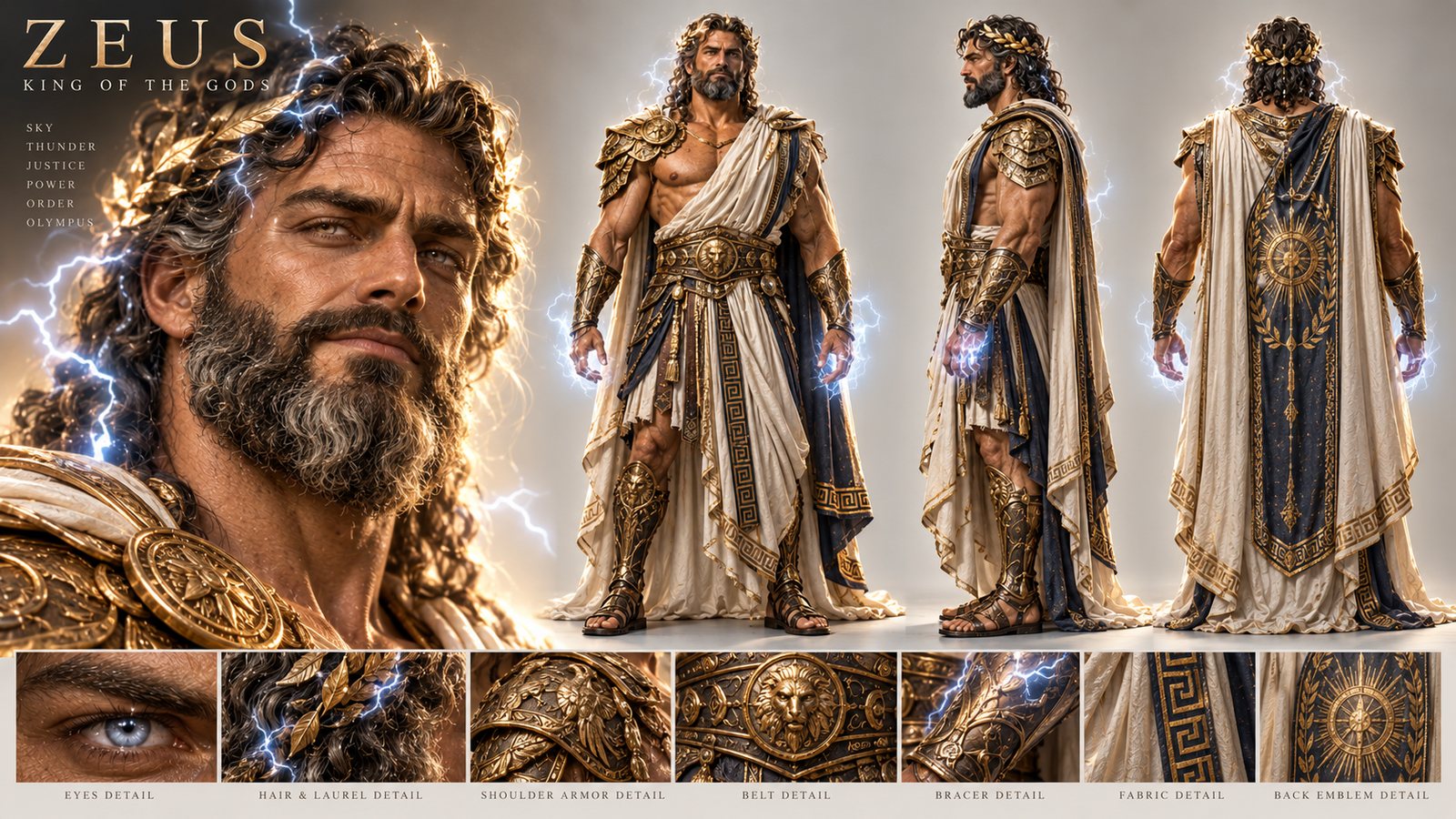
Every character in Navy Cinematics starts life as a dossier, not a shot. Before anyone thinks about motion, the figure is pinned down from every angle: front, profile, back, and then the close details that sell the myth — the brooch, the belt, the weapon, the symbol stitched into a cloak.
It’s a discipline borrowed from film and game production. A character sheet forces the hard questions early. What has this god survived? Odin’s single eye and raven companions aren’t decoration — they’re the price he paid for wisdom, worn on his face. Zeus’ laurel and lightning say power inherited, not earned through loss. The costume is the backstory.
Consistency is the other reason. When a character appears across teasers, posters and scenes, the sheet is the single source of truth that keeps the face, the armor and the palette identical every time. Without it, AI-generated figures drift — a different nose here, a different cloak there. With it, the god stays the same god.
The detail crops matter most. A shoulder brooch shaped like a raven, runes along a spear, the weave of fur at a collar — these are the touches that make a generated image feel designed rather than dreamed. They’re also what let viewers recognise a character instantly, the way you’d know a hero by their silhouette.
By the time a god is ready to move, you already know them. That’s the goal of the dossier: not just a look, but a life — mapped out in gold and shadow before the camera ever rolls.